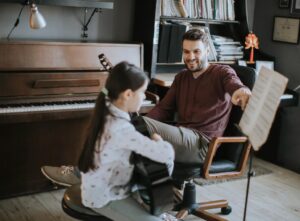
By the time a weekday evening arrives, most families are running on fumes. Homework, dinner, the drive to one more activity. The idea of loading an instrument into the car and fighting traffic for a 4:30 lesson can be the thing that finally makes music feel like one obligation too many. Taking music lessons in your home removes that friction: the teacher comes to you, the lesson happens where your child already feels comfortable, and the instrument they practice on all week is the one they learn on. Lessons In Your Home has built its whole approach around that shift, and the reasons it works run deeper than saving a drive.
How In-Home Lessons Fit Around a Busy Family’s Week
In-home lessons remove the single biggest reason families skip a lesson: the commute. When the teacher arrives at your door, there is no packing up, no traffic, no waiting room. We schedule around the rhythm of your week and arrive when your child is most ready to focus, instead of after a draining cross-town drive at the end of a long day. Lessons that are easy to keep are the ones that happen, and steady progress quietly comes from fewer cancellations. A child who has lessons consistently, in a time slot that fits naturally into the family’s routine, is far more likely to make steady progress than one whose schedule is constantly interrupted.
Practicing Where You Learn Builds Momentum
Learning an instrument lives or dies on what happens between lessons. A child who practices on the same piano, in the same corner of the same room where the lesson took place, has an easier time recalling what the teacher showed them. The setting itself becomes a cue. For a beginner staring down 88 keys for the first time, that continuity lowers the mental load of remembering where to put their hands and what to work on next. When the lesson and the practice session share a room, the week between them feels less like starting over and more like picking up where things left off. A studio can’t offer that overlap, because the instrument at the studio is never the instrument at home.
Why Comfort Helps Young and Nervous Beginners Open Up
Plenty of young students arrive at music with more nerves than excitement. Sitting down to do something new is hard enough without doing it in a strange room while a parent waits down the hall. At home, surrounded by familiar things, a cautious child is more willing to try, fumble, and try again, which is what early learning asks of them. Music is built on small risks: testing a note, guessing at a rhythm, being wrong out loud, and kids take those risks more readily when they feel safe.
The same comfort lets a teacher meet each student exactly where they are. A pace built around one child is nearly impossible in a crowded room, and it tends to be the part of in-home teaching that surprises parents most. For a fuller picture of how lessons shape focus and confidence over time, our look at the benefits of music education for children goes deeper.
What Progress Looks Like for Three Different Students
The in-home format flexes to fit the learner, not the other way around. Three of our students, each starting from a very different place, show what that can look like.
Jayden, the reluctant beginner. At seven, he came to piano shy and short on confidence, thrown by transitions after a group music class had left him overwhelmed. Weekly lessons in his own home, with the same teacher using games and flexible pacing toward small, reachable goals, gave him room to settle. By week six he was playing with both hands and smiling about it, and his parents now call music his safe place.
Lily, the self-taught songwriter. At thirteen, she arrived with the opposite challenge. She loved singing and songwriting and had taught herself guitar, but formal lessons made her nervous and her technical grounding was thin. Her teacher combined voice and guitar in a single in-home session, worked on vocal health and pitch control, and built her own songs into the lessons. She is now recording her music with more range, more control, and the confidence to write a piece for her school’s talent show.
Mr. Ruiz, the retiree starting fresh. He took up the saxophone at sixty-eight, once retirement finally gave him the time. A complete beginner with mild arthritis, he needed gentle pacing, so his teacher built in breaks, adapted fingerings for comfort, and focused on tone, breath, and songs he already loved. Six months in, he plays simple jazz standards and practices every day, and he calls it the most fun he has had learning anything in years.
The Relationship a Home Lesson Makes Possible
A teacher who comes to your home sees things a studio teacher never will. They notice the practice space, the sibling who wanders in curious, the family dog that shows up for every lesson, the small things competing for a child’s attention. Seeing the whole picture lets them adjust how they teach and what they aim for week to week. The lesson stops being a transaction in a sterile room and becomes part of the household.
Parents notice the difference too. Some sit in on every lesson and others stay within earshot, and either way you can see the teaching happen and stay as involved as you want to be. Watching the work up close builds trust faster than a monthly progress email, which is also why who we send matters so much. Every one of our personally matched, background-checked music teachers is trained and supported by the company and paired with your child by instrument, schedule, personality, and goals, rather than assigned at random. Inviting someone into your home to teach your kid is a real act of trust, and we treat it that way.
What to Weigh Before You Choose In-Home Lessons
In-home lessons are not the right fit for every family, and the trade-offs are worth naming:
- Space: lessons work best in a reasonably quiet spot where the television or a busy kitchen won’t pull focus, though it doesn’t need to be a dedicated music room.
- Peer atmosphere: a child who is energized by learning alongside other kids may miss the social side of a studio, which recitals and group opportunities can partly fill.
- Cost: because a teacher travels to you and gives fully one-on-one attention, in-home lessons usually run a bit more than a group class at a studio.
What that cost covers is the time you save, the consistency of learning and practicing in one place, and instruction shaped around a single student.
For families who love the in-home model but run into a distance or scheduling snag, virtual music lessons cover the gap. Our online lessons are taught live by local teachers, so a tricky week doesn’t have to mean missing music altogether. Many families end up mixing the two, leaning on in-home most weeks and online when life gets complicated.
Start With a Teacher Who Comes to You
The right setting won’t turn a reluctant child into a prodigy, but it removes the friction between wanting to learn and sitting down to do it. We’ve spent nearly three decades watching kids stay with music longer when it lives inside their real days, taught by someone who knows them well. The belief that the relationship and the room a child learns in shape progress as much as raw talent is why Lessons In Your Home brings the lesson to you instead of asking you to come to it.
Tell us a little about your child, and we’ll match them with a teacher who fits their instrument, personality, and schedule.
Frequently Asked Questions
Do I need my own instrument at home for lessons?
For piano and keyboard students, yes. The lesson and weekly practice should happen on the same keys, so an instrument at home matters. For most other instruments, students usually have their own, and we’re glad to help you decide what to buy or rent before lessons begin.
Which instruments can my child learn through in-home lessons?
We teach piano, guitar, voice, violin, drums, and band and orchestra instruments, among others, all in your home. The right starting instrument depends on your child’s age, interests, and physical readiness, and we’re happy to talk it through if you’re undecided. A teacher matched to that instrument comes to you for every lesson.
Are in-home music lessons a good fit for shy or very young beginners?
Often, yes. A familiar room lowers the nerves that can make a new activity feel overwhelming, and a comfortable child takes the small risks that early learning requires. One-on-one attention also lets the teacher set a pace built around your child instead of a group.
How can I support my child’s practice between lessons?
The most useful thing parents do is protect a small, regular practice window rather than pushing for long sessions. A consistent spot with the instrument set up and ready lowers the friction that makes kids skip practice. Your teacher sends clear, manageable goals each week, so you don’t need a music background to help your child stay on track.
What if my home is small or tends to be noisy?
A dedicated music room isn’t necessary. A quiet corner with the instrument and a little distance from the television usually does the job, and your teacher can suggest small adjustments once they see the space. When a calm spot is genuinely hard to find, online lessons with a local teacher are a workable alternative.
Are online music lessons as effective as in-person lessons at home?
For many students they’re highly effective, especially older kids and anyone comfortable on a screen. Very young beginners and certain hands-on instruments tend to do better in person, where a teacher can adjust posture and hand position directly. Plenty of families use both, choosing the format that fits each week.