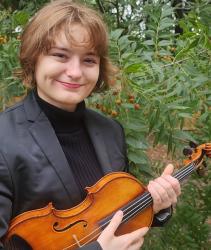
Chloe Svadlenka now teaches violin students of her own in Dallas, which means there are children who know her only as their teacher. To them, she is the person who walks in with the violin case, listens carefully, gives direction, encourages practice, and helps make the instrument feel a little less intimidating.
They probably do not know that years earlier, Chloe was the one sitting in the student’s chair.
When Chloe was 15, she studied violin with Phoenix Abbo through Lessons In Your Home. She was a serious student, the kind of teenager who already had a strong sense that music mattered to her. Phoenix remembers her as calm, kind, and determined. She worked hard, listened well, and carried herself with the quiet focus of someone who wanted to grow.
At that age, music lessons can become more than weekly instruction. A student is still learning technique, scales, rhythm, tone, and repertoire, but they are also learning how to stay with something difficult. They are learning how to be corrected without giving up. They are learning how to prepare, how to listen, how to trust another person’s guidance, and how to keep going when progress feels slow.
Phoenix was part of that season for Chloe.
Years later, the story came back around in a way that does not happen every day. Chloe, now finishing her senior year at the University of North Texas, joined the Lessons In Your Home team as a violin teacher in Dallas. The former student had become the teacher.
That is a special kind of full circle.
It is easy to look at a story like Chloe’s and make it only about achievement. A young violin student keeps working, continues studying music, goes to college, and eventually teaches. That is certainly worth celebrating. But there is something more meaningful underneath it.
Good teaching does not always stay in the lesson where it first happens. Sometimes it travels with the student.
A teacher’s patience, tone, expectations, encouragement, and example can become part of how a student understands music. Later, if that student becomes a teacher, those same qualities may appear again in a new form. Not as an imitation, and not as a script, but as an influence. A student remembers how it felt to be guided well, and that memory can shape the way they guide someone else.
That is what makes Chloe’s story so meaningful. She is not just someone who learned violin and now teaches violin. She is someone who experienced the student side of the relationship first. She knows what it feels like to be young and learning, to be challenged, to need patience, and to have a teacher believe she could keep improving.
Now she gets to offer that to her own students.
There is something beautiful about that. The lessons Phoenix taught Chloe did not end when Chloe grew up. Some part of them continued forward, carried into new homes, new students, and new relationships. The music is still there, of course. The violin is still there. The technique still matters. But the human part of the lesson is there too.
Somewhere in Chloe’s teaching, there are probably small pieces of the lessons she once received from Phoenix. Not copied exactly, and not frozen in time, but carried forward in her own way.
That may be one of the best things a music teacher can hope for: not only that a student learns the instrument, but that something good from the relationship keeps moving.