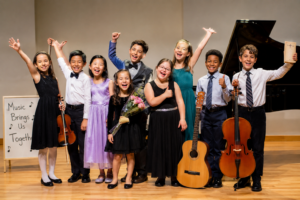
In some homes, music lessons are something that happen in one room, with one student, for thirty minutes at a time.
In this house, music seemed to spread.
There were five children, which meant there was already plenty of motion, noise, personality, and life before the first note was ever played. A home like that does not need music to make it lively. It already is. The music simply becomes part of the rhythm that is already there.
Each child came to lessons differently. Some were more eager. Some needed more encouragement. Some were ready to sit and focus, while others needed a little more time to settle in. That is true in almost every family, but with five children, those differences are easier to see. No two students walk into a lesson as the same person, even when they live under the same roof.
One of the children had Down syndrome, and that was part of the family’s story, but it was not the whole story. She was not treated as separate from the musical life of the house. She was part of it. The goal was not to force every child to learn in the same way or move at the same pace. The goal was to help each child find a way into the music.
That is where in-home lessons can be so meaningful. A teacher is not meeting a child in isolation. They are stepping into a real home, with siblings nearby, parents listening from another room, and all the little details that make a family what it is. The teacher gets to see how a child responds in their own environment. They get to notice what makes them comfortable, what makes them laugh, what helps them try again.
In this family, music became something more than an activity on the calendar. It became part of the household. One child’s lesson could encourage another child to listen. One child’s progress could become something everyone noticed. A song learned at the piano or another instrument did not stay locked inside the lesson. It moved through the home.
For a child with special needs, that kind of belonging matters. Not because music has to become therapy, and not because every moment needs to be turned into a milestone, but because every child deserves the chance to participate in something beautiful. Music gives students a way to be heard, even when words are not always easy. It gives them a place to try, to repeat, to succeed, and to be seen.
The best moments in a lesson are not always dramatic. Sometimes they are very small. A student remembers a pattern. A child who was hesitant reaches for the keys. A sibling hears a familiar song from the next room. A parent sees confidence appear where there used to be uncertainty.
Those moments do not always look like much from the outside. But inside a family, they can mean a great deal.
This is one of the things music can do when it becomes part of a home. It can meet children where they are. It can make room for different personalities, different abilities, and different ways of learning. It can give a family something shared without requiring everyone to experience it the same way.
That may be what music gave this family most. Not perfection. Not everyone moving at the same pace. Not a house full of identical students.
A shared place to belong.
And in a house with five children, that is no small thing.