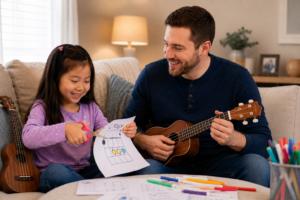
Ukulele Lessons for Shy Beginners
When Brian first told me about Joy, I understood the situation right away.
Joy was six years old, brand new to ukulele, and very shy. At the first lesson, she was quiet, but she participated enough that Brian felt like there was something to build on. That is pretty normal with young beginners. Sometimes the first lesson is less about music and more about everyone getting used to each other.
Then came the second lesson.
Joy would not touch the ukulele.
Not once.
Now, if you teach long enough, you know this moment. The lesson is scheduled. The teacher is there. The parent is nearby. The instrument is ready. Everyone wants this to work, and the child wants nothing to do with the thing they are supposed to be learning.
That can make a teacher nervous.
It is easy to start thinking, “What am I supposed to do now?” Do I push? Do I make a game out of it? Do I tell the parent we need more time? Do I keep trying to get the ukulele in her hands?
Brian did something better.
He slowed down.
He did not turn the ukulele into a battle. He did not make Joy feel like the whole lesson depended on whether she picked it up. He kept showing up, kept being kind, and kept looking for little ways to make her comfortable.
That may not sound like a big teaching strategy, but it is.
With a shy six-year-old, the instrument is not always the first thing you teach. Sometimes the first thing you teach is, “You are safe here.” Then, “I am not going to embarrass you.” Then, “You can try when you are ready.”
Only after that does the ukulele have a real chance.
For several lessons, Brian walked into that house knowing Joy might not play. That is not easy. A teacher wants to help. A parent wants to see progress. Everyone naturally wants the lesson to look like a lesson.
But sometimes the lesson is happening before the child ever plays a note.
Joy was watching Brian. She was figuring him out. Would he get frustrated? Would he pressure her? Would he still be patient if she stayed quiet? Would he let her be shy without making her feel bad about it?
Those questions matter to a child, even if they never say them out loud.
Eventually, Joy started to come around. Not all at once. It was not some big dramatic moment where everything changed in five minutes. It was smaller than that. She got a little more comfortable. She trusted Brian a little more. The room felt a little easier.
And eventually, the ukulele was not just sitting there anymore.
That is the part I like most about this story. Brian did not win Joy over by forcing the lesson to happen. He gave the relationship enough time to do its work.
The music came after that.
For young beginners, especially shy ones, that order matters. We can have the best method book, the right instrument, the perfect first song, and a well-planned lesson. But if the child does not feel comfortable with the teacher yet, none of that matters very much.
Joy did not need a teacher who could rush her into playing.
She needed one who could wait with her until she was ready to begin.