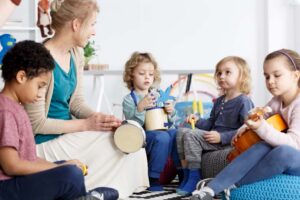
Parents sign their kids up for music lessons for all kinds of reasons. A child begged to learn guitar after seeing someone play at school. A parent wants to give their kid a creative outlet. Someone read that music helps with brain development and thought, why not?
Whatever the starting point, most families are surprised by how much happens beyond the music itself. The benefits of music education for children go deeper than learning to read notes or play a song. Over months and years, children become more patient, more expressive, and more willing to push through hard things, and parents start noticing those changes show up well outside the lesson room.
We’ve been doing this since 1997, and if there’s one thing we’ve learned, it’s that the music is almost never the biggest part of what a child takes away.
Confidence That Comes from Actually Doing Something Hard
Confidence can’t be given to a child. It has to be built through experience, and music gives children a clear, repeatable path to that experience. A child who struggles with a difficult measure and finally gets it right has learned something real about themselves. A student who performs at a recital for the first time and survives the nerves carries that memory forward. Week after week, small wins accumulate into a genuinely stronger sense of self.
Not the kind that requires constant praise, but the kind that comes from knowing: I did something hard, and I did it.
Children who are quiet and hesitant in group settings often open up completely in a one-on-one lesson with a teacher who genuinely knows them. They try things they wouldn’t risk in a classroom, and when recital time comes, many of them surprise everyone, including themselves. One of our teachers described watching his students at their first recital, many of them visibly nervous, stepping onto the stage and finding their footing. He said it reminded him exactly why he teaches.

Creativity Is More Than Making Things Up
Music is one of the clearest environments children can discover their own creative voice, and it often starts with smaller choices than most people expect. How fast to play a phrase, how to shape the ending of a song, or whether something feels quiet or urgent. Two students can learn the exact same piece and make it sound completely different because they each hear it differently, and that realization, that their interpretation matters and their instincts are valid, is meaningful for a child to absorb.
As children develop their skills, that creative freedom grows. Through improvisation, they learn to think spontaneously and trust their own musical ideas rather than waiting to be told what to do. Some explore basic composition, making choices about melody and structure that are entirely their own. One of our teachers put it simply: she sees students use music to express what they can’t always find words for. They naturally turn to their instrument the way other kids might turn to a journal, and she finds it remarkable to witness.
Your child may experience the same thing. You might notice them playing something freely after a hard day, or finding a song that feels like it belongs to them in a way they can’t quite explain.
What Happens to the Brain During Music Lessons
Learning to play an instrument exercises the brain in an unusually full way. Reading music, coordinating hands, listening to pitch, managing rhythm, and interpreting expression all happen at once, and over time that kind of multi-layered engagement builds stronger neural connections that support learning in many areas.
A five-year study by USC’s Brain and Creativity Institute found that music instruction speeds up the maturation of the auditory pathway in the brain, the system responsible for processing sound, and that this accelerated development supports language acquisition, speech perception, and reading skills in young children. Children with music training were measurably more accurate at processing sound than their peers without it.
Parents and teachers regularly notice related improvements across several areas:
- Reading and language skills, because musical training sharpens the ear’s ability to distinguish sounds, which directly supports how children learn to read and process language
- Attention span, because regular practice asks children to focus on a single task for extended periods, building the kind of sustained concentration that transfers into school
- Problem-solving and pattern recognition, because learning to decode and interpret music requires children to break down complex information and find solutions step by step
- Working memory, because holding a melody in mind while reading ahead, or remembering a chord progression, is the same cognitive work children do when following multi-step instructions
We’re not saying music lessons are a magic fix for anything. But the benefits of music education for children consistently point in the same direction: it builds a brain that is more engaged, more flexible, and more ready to take on new challenges.
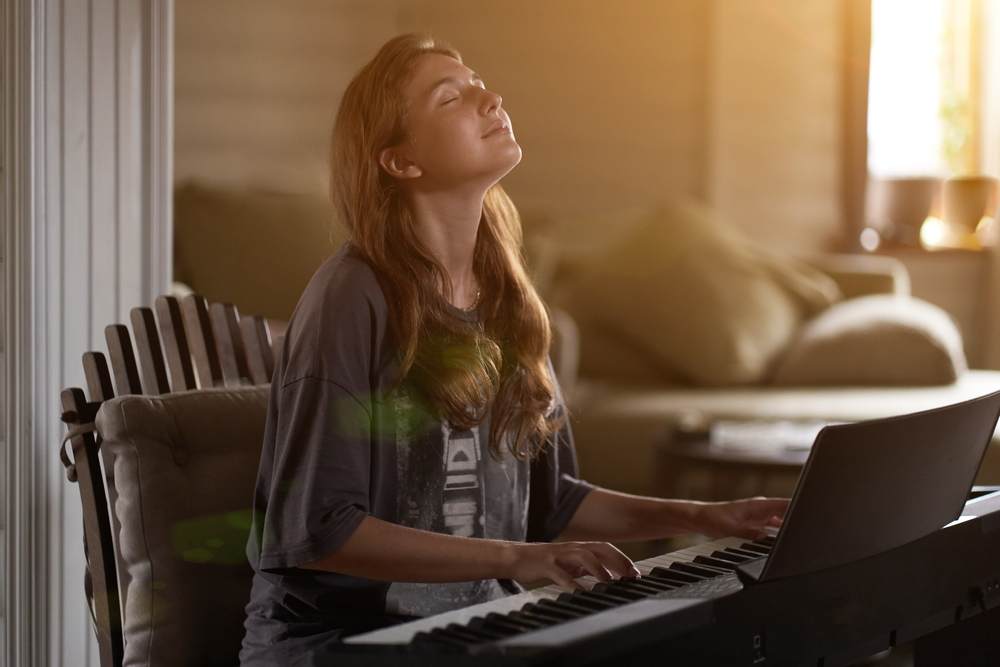
Music Gives Kids a Place to Belong
Children who take music lessons often find something they didn’t expect: a genuine sense of community. For kids who struggle to connect in group settings, the one-on-one relationship with a teacher who actually knows them can be a meaningful turning point. Our founder Jay Maurice started teaching in Atlanta in 1997, going into homes week after week, and he’ll tell you that he wasn’t just shaping musicians. He was becoming part of families.
Parents would pull him aside before lessons: “Can you go easy on her today? She had a rough week at school and didn’t get much time on the piano.” Those conversations shaped how we think about what a music teacher actually is. Not just someone who corrects finger placement, but someone who shows up consistently and pays attention to the whole child.
Ensemble settings add another layer to all of this. In orchestra, band, or group lessons, children discover that making music together requires listening and contributing in equal measure. Every player has a part that matters, and that kind of shared effort builds friendships that are sometimes hard to explain but easy to recognize. Musicians develop a common language, and for many children, that shared understanding becomes the foundation of some of their closest connections.
Perseverance Is the Biggest Thing Music Teaches
Learning an instrument follows a reliable cycle at every level: a child learns a skill, hits a wall, works through it, and moves forward, only to repeat the process at the next stage of difficulty. As they progress, the material gets more demanding and more rewarding in equal measure. Every time a child pushes through a passage that wouldn’t cooperate and finally gets it right, they internalize something important: consistent effort produces real results.
Jordan, one of our teachers, says he goes to bed thinking about how he can be a better communicator for his students. He doesn’t see a finish line in his own practice as a teacher, and he brings that same openness to his students. “We keep the goal,” he says, “but we might change the path.” That kind of flexibility is what helps children stay in it long enough to discover what they’re really capable of.
A quieter benefit develops alongside perseverance: empathy. Because every musician starts at zero, children experience firsthand what it feels like to struggle and improve slowly. That experience makes them more patient with others who are still learning, more willing to extend the kind of grace they once needed themselves. Music gives children a felt sense of what real effort looks like, and that awareness tends to make them kinder in ways that have nothing to do with music at all.
The Long View: Music Doesn’t Have a Finish Line
Parents often ask how long their child should take lessons, or what the end goal is supposed to be. Music rarely has a single destination. Some children study for a few years and step away with skills they’ll carry quietly through adulthood. Others fall deeply in love with an instrument and never really stop. Some come back to music later, in college or after a difficult season, and find it waiting for them.
Jay ran into a former student years after her lessons ended. She told him she’ll always have a piano in her home because music brings her peace. She has children of her own now. She thanked him for being the person who gave that to her. He says moments like that are what the whole thing is for.
For children who feel a deeper pull toward music, it’s worth knowing just how wide the field actually is. Most families are surprised. Beyond performing, there are careers in music production, recording engineering, music education, composition, artist management, music journalism, and more. A child who loves music doesn’t have to choose between “going professional” and leaving it behind entirely. There’s a lot of territory in between, and none of it requires choosing a direction early.
All of those paths hold real value. What a child eventually does with music matters far less than what music does for them along the way: the patience, the self-expression, the ability to push through something genuinely difficult and feel proud of where they landed. A useful way to think about it is in seasons rather than endpoints. At the end of each season, a few honest questions are worth asking: Is my child still curious about their instrument? Do they take pride in what they’ve learned? Is there a new teacher, style, or challenge that might open things back up? Children can grow in music at any stage, and motivation often returns in unexpected ways when the conditions are right.
READ: Encouraging Kids To Stick With Music Lessons
Why the Teacher Relationship Matters Most
At Lessons in Your Home, we’ve always believed that the connection between a teacher and a child has more value than the lessons themselves. It’s the idea we built this school on, and it shapes everything about how we match teachers to students.
Our teachers come to you. There’s no unfamiliar studio to adjust to, no waiting room, no performing for strangers before a child feels ready. Lessons happen in a familiar space, with a teacher whose full attention belongs to your child for that hour. For many kids, especially those who shut down in group settings, that environment is where they finally find their footing.
We tell every new family the same thing when they join us: welcome to our family. We mean it. Other schools might call you a customer or an account. To us, you’re a family, and we take that seriously every single week.
READ: What Makes Great Music Lessons for Kids (Our Teaching Philosophy)
For Parents Still Deciding
The benefits of music education for children reach far beyond what shows up at a recital. The patience, the creative confidence, the willingness to work through something genuinely difficult, those qualities aren’t side effects of learning music. They are the point. Your child doesn’t need to dream of a career in music to deserve that kind of foundation, just a good teacher, some consistency, and the space to grow at their own pace.
If you’re ready to get started, or if your child has tried lessons before and needs a fresh match with someone who truly gets them, reach out to us at Lessons in Your Home. We’ll take the time to find the right fit.
Lessons In Your Home offers private instruction in piano, guitar, voice, violin, drums, and more, taught by experienced teachers who come to you. Find a teacher near you.