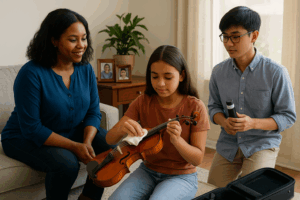
When parents come to us about starting music lessons, the first question is almost always about piano or guitar. Both are wonderful starting points, with low setup friction, plenty of qualified teachers, and the kind of early wins that keep a child engaged. But the default first instrument isn’t always the right one for a particular child, and we’ve spent enough years matching students with teachers to know how often a slightly less obvious instrument turns out to be the one that clicks. Drums, violin, and voice each offer something piano and guitar can’t, and each suits a different kind of child.
Why Some Kids Thrive on Instruments Beyond Piano and Guitar
Piano teaches music theory cleanly. Guitar gives quick wins on familiar songs. Neither is a bad place to start, and we love teaching both. But the most common first instrument isn’t always the right first instrument for the child sitting in front of you, and the match between child and instrument matters more than parents often realize. A physical kid who responds to rhythm before melody is a different student than a careful kid who likes precision and subtle improvement, and putting them on the same instrument by default usually means one of them quietly stops practicing within a few months.
Drums, violin, and voice cover three distinct territories. Drums are about coordination and rhythm, the language of the body in time. Violin is about detail and tone, a slow craft that rewards careful attention. Voice is about the instrument every child already carries with them. Knowing which of these speaks to your child is the question worth sitting with.
Read: Other instruments to learn after piano
What Drum Lessons Look Like for Kids
Inside a beginner drum lesson
Drum lessons surprise most parents. The first few weeks rarely involve a full kit, because what a beginning drummer needs to learn first is control over the sticks. Students start with rudiments (basic stick patterns like single strokes) on a drum pad with a metronome ticking quietly in the background. From there comes coordination across four limbs, where right hand, left hand, right foot, and left foot each carry their own pattern. It’s a beautiful thing to watch a kid figure out for the first time. Drummers also read music, by the way. The notation looks different from piano music, but the rhythm values are the same, and music theory is part of the work from the very first month.
The myth that drums are just “hitting things” doesn’t survive contact with a real lesson. Great drummers shape rhythm patterns within a steady beat, build fills, and control dynamics with the same musicianship a pianist or violinist brings to their instrument. Plenty of kids come to drums looking for an outlet for their energy and end up falling in love with the craft of it.
Who drums tend to suit
Drums work well for kids who can’t quite sit still long enough for a melodic instrument to feel right. Physical, energetic kids often light up the moment they get behind a kit, and parents who’d tried piano or violin first sometimes tell us they wished they’d started here. Younger children who already respond to rhythm before melody (a common pattern in early childhood) often find drums approachable in a way that violin or voice wouldn’t be at the same age.
Handling noise, space, and cost
Parents ask about noise and space before anything else, and both concerns have practical fixes. Acoustic kits are loud, yes, but electronic kits with headphones solve the household problem, and practice pads let students drill rudiments silently when the house needs quiet. A starting setup doesn’t need a full kit either; a snare, hi-hat, and kick drum cover most beginner work, and electronic kits break down to store easily. Starter setups run around $300 new, with used kits much lower, which is comparable to or cheaper than starting on most other instruments. The household-impact concern that keeps so many parents from saying yes is usually softer than they think once they’ve seen the options.
Read: Debunking Drum Lesson Myths
What progress looks like in the first weeks
A practice pad ($16) and sticks ($6) are enough to begin. First lessons cover grip, posture, and the single-stroke rudiment, and within a few weeks most students can play a simple rock groove (hi-hat keeping eighth notes, bass on 1 and 3, snare on 2 and 4). Drums are easier to start than violin and harder to master than most parents expect, because the coordination across four limbs takes time and patience to build. We tell parents from day one that the joy of drums comes early, and the depth comes later, and both are worth the wait.
What Violin Lessons Teach Young Beginners
Why violin is the instrument of detail
Violin is the instrument of detail. Where piano gives many notes at once and drums give rhythm, violin gives control over every sound the instrument produces. A violinist plays one note at a time, but a skilled player shapes every one of those notes with techniques like vibrato (a quick shimmering movement), spiccato (a bouncing bow stroke), portato (a gently pulsing articulation), and glissando (sliding between notes). Learning these techniques is how a violinist brings a piece to life, and knowing when to use each one matters as much as knowing how. Our violin teachers love this part of the work, because watching a student discover that they can shape a note (not only play it) is one of the most rewarding moments in music education.
The central challenge for beginners is intonation, or playing in tune without frets. The violin has no markers like a guitar, so students learn finger placement by feel and ear, and most beginners place tape along the fingerboard at first to find the right spots. Correct intonation can take years to develop fully, and a skilled teacher makes that early work go faster.
Inside a beginner violin lesson
Posture affects everything else on violin. Bow grip, violin hold, hand angle, finger spacing, all of it directly affects how a note sounds, in tune or out, smooth or scratchy. A skilled teacher catches a tight neck grip, a drooping left hand, or a tight right elbow before they harden into habits, and that early correction is one of the things parents are paying for when they put their child in private lessons.
Choosing a teaching method
A few different methods dominate violin instruction today. The Suzuki method is popular for young beginners because it teaches by ear before reading music, which suits children who learn well through listening and imitation. The O’Connor method has gained ground in recent years, especially among teachers who want to weave American folk and fiddle traditions into classical training. Traditional approaches teach theory and notation early. All of them work in the right hands, and a strong teacher chooses the method that fits the student rather than the other way around.
Who violin tends to suit
Violin tends to suit kids with patience for slow foundational work. The first months are about getting posture and bow grip right before much music happens, and parents who don’t know to expect that sometimes mistake the slowness for lack of progress. Kids who like precision and respond to subtle improvement tend to thrive on violin, and so do naturally curious or musical kids who already enjoy listening, because violin develops the ear in a way no other instrument quite matches. If your child notices when a song on the radio is slightly out of tune, that’s a clue worth paying attention to.
Sizing, gear, and care
The practical reality every violin family deals with is sizing. Violins come in fractional sizes (1/16, 1/10, 1/8, 1/4, 1/2, 3/4, and full size around ages 11 to 12), and a 1/16 violin is small enough to fit in a young child’s lap, almost like an ornament. Students size up roughly every one to two years, which is why most families rent rather than buy. Other gear is modest: a shoulder rest, rosin for the bow, and a music stand. Temperature and humidity affect tuning, so a violin should never sit in a car. The first time a parent forgets that and finds the strings wildly out of tune is usually the only time it happens.
What progress looks like in the first months
First lessons cover holding the violin, holding the bow, and plucking the open strings before any bowing begins. Simple songs are usually achievable within three to six months of consistent practice, and intermediate playing takes one to two years. Violin is harder to start than most instruments, but the rewards compound over time: tone, expression, and an ear that carries into every other musical pursuit your child takes up later.
How Voice Lessons Work for Kids
The voice is an instrument
The voice is an instrument, and like any instrument, it can be trained. The “born with it” assumption holds back a lot of kids who would thrive in lessons, when in fact anyone who can talk can learn to sing with more control, range, and confidence than they started with. Voice lessons cover serious technique, and most parents are surprised by how much there is to learn beyond singing the notes on a page.
What voice lessons cover
The technique taught breaks down into five areas:
- Breathing. Diaphragmatic breath support changes how a singing voice sounds within a few weeks of practice, while shallow chest breathing produces the strained, nasal tone parents sometimes want their child to grow out of.
- Posture. Standing or sitting tall makes room for the diaphragm to expand, which is why posture sits alongside breathing in almost every lesson.
- Tone. The unique quality of each voice. Teachers work on shaping resonance and air flow to develop a healthy, clear sound that’s recognizably your child.
- Diction. How words are pronounced when sung, with attention to vowel shape and consonant articulation. Singing a word and speaking it are different mechanical actions, and that surprises most beginners.
- Intonation. Matching pitches accurately, which can be trained even for kids who start out struggling with it. A child who’s been called “off-pitch” at home can become a confident singer inside of a year with the right exercises.
Who voice tends to suit
Voice lessons tend to suit kids who already love singing. The household giveaway is the child who sings while doing other things, in the car, in the shower, walking around the house humming a song they don’t fully know the words to. That natural enthusiasm tells you they’ll engage. Voice lessons can also be a particularly good fit for shy kids who express themselves more easily through singing than talking, because the one-on-one environment removes the audience and gives space for confidence to build in a way group settings can’t.
The lowest-friction instrument to start
The voice has one practical advantage no other instrument can match: no equipment to start. No purchase, no rental, no instrument to size up as the child grows. Vocal health does need attention, because yelling at play, dehydration, and strained singing all affect young voices, and a good teacher watches for these and gently coaches the family on how to protect them.
What early voice lessons look like
First lessons usually cover breathing exercises, posture, and gentle pitch-matching games. No performance pressure, no audition energy. Within a few months of consistent practice, most kids can sustain a tune, sing comfortably in their natural range, and match pitch on a small scale.
Other Instruments Worth Exploring
Drums, violin, and voice aren’t the only paths beyond piano and guitar. A few other options worth considering:
- Cello. Suits kids drawn to deeper string tones. Starts fairly young with fractional sizes, much like violin.
- Viola. A close cousin to violin with a slightly larger body and lower, warmer voice. Good for string-curious kids who want something a little less common.
- Ukulele. Small, approachable, and often a lower commitment than guitar for young beginners.
- Bass guitar. A natural fit for kids who love rhythm but want a melodic role, and it pairs beautifully with drums or piano in any family band.
- Saxophone. A school-band favorite that crosses genres easily, from jazz to pop to rock. Usually starts around age 10 once the child has the breath support.
- Clarinet or flute. Woodwinds usually start once kids have the breath control to support a sustained tone, around age 9 or 10.
- Trumpet. Achievable for school-age kids since the mouthpieces are small enough for younger players, with a clear path into school band and orchestra programs.
The right instrument is the one your child connects with, not the one with the lowest barrier or the highest prestige. Some kids know which sound calls them long before lessons start; others need to hear a few options live before they can tell. We teach a wide range of instruments, with band and orchestra options for kids whose interests lead them there.
How Lessons In Your Home Matches Students With the Right Instrument
The choice of instrument is the family’s, but you don’t have to make it alone. We’re glad to talk it through with you, and once you’ve landed on the instrument, our job is to find the right teacher for your child.
More than just availability, we consider instrument, schedule, location, personality, goals, and learning needs, when matching a teacher who fits the child sitting in front of us. Every teacher we work with is vetted, trained, and supported across the full range of instruments we cover, from drums to violin to voice and beyond. And in nearly three decades of doing this since 1997, we’ve learned something simple: how much a child looks forward to a lesson comes down to the quality of the match as much as the quality of the teaching.
Start Your Child’s Music Lessons With Lessons In Your Home
Most kids will thrive on more than one instrument over the course of their childhood. The question is which one will hold their attention long enough to build the foundation that lets everything else follow.
Children learn best when they feel known, supported, and free to grow at their own pace, and our job is to give your child a teacher who creates exactly that kind of space. Tell us a little about your child, and we’ll help match them with a teacher who fits their instrument, personality, and schedule.
Frequently Asked Questions
What age can my child start music lessons on drums, violin, or voice?
There’s no single right age. Some children start as young as 4 or 5, others find their footing closer to 8 or 9, and both paths work. Drum and voice lessons often begin around age 7 or 8, and violin can start earlier with a properly sized instrument and a patient teacher. What matters more than the number is how the lessons are built around the child sitting in front of the teacher, because readiness is about focus, enthusiasm, and the right pacing, not a calendar date.
What is the easiest of these three instruments for a child to learn?
All three have real learning curves. Drums tend to produce recognizable beats fastest. Voice has no equipment barrier to clear. Violin has the steepest start but rewards careful early work with skills that compound over years.
Do you need to read music to start drum lessons?
Not on day one. Students start with rudiments by ear, practicing on a drum pad with a metronome. Music reading gets introduced as students progress, and drum notation follows the same rhythm values as other instruments.
Are drums too loud for an apartment?
Acoustic kits are loud, yes. Electronic kits with headphones are nearly silent for the household, and practice pads let students drill rudiments quietly when needed. Most apartment-based drum students use some combination of the two.
Why are violin lessons considered hard?
There are no frets on a violin, so students learn finger placement by feel and ear. Posture, bow grip, and intonation all develop together, and the first few months feel slow because the foundation has to be right before more advanced playing works.
Can my child take voice lessons before their voice changes?
Yes. Breath support, posture, ear training, and pitch matching can all start well before any voice change, and the techniques carry through the change naturally. Many singers who start young keep using the foundations they built in childhood for the rest of their singing lives.