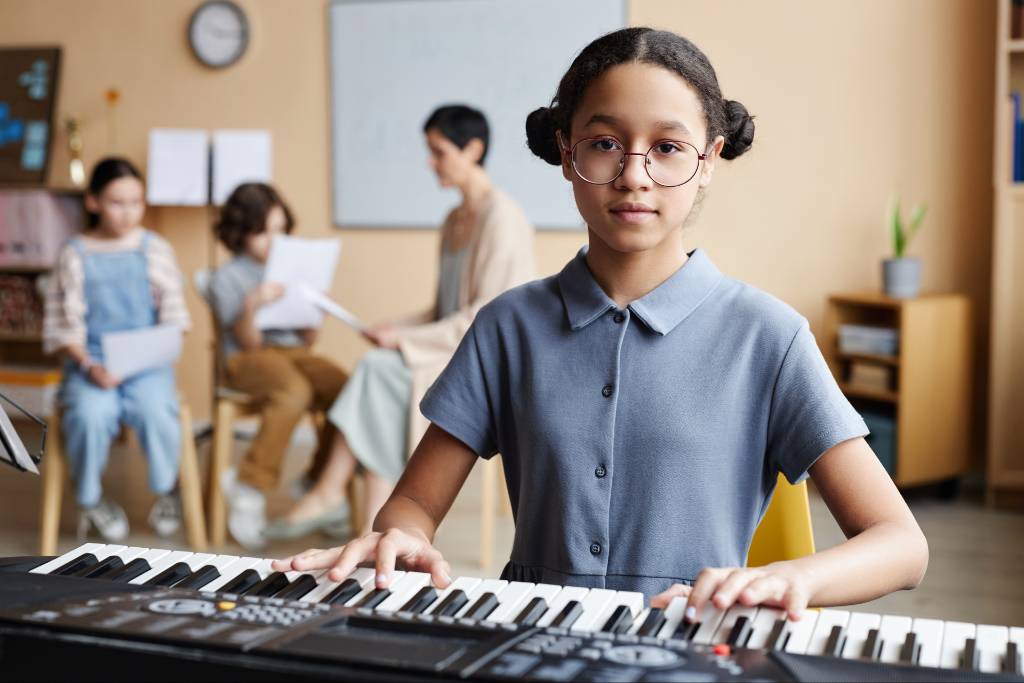
Six weeks out from a spring recital, something shifts in a lot of students. A piece that was getting ten distracted minutes a day starts getting thirty focused ones, because a real audience is coming and the date is on the calendar. Recitals do most of their quiet work in those weeks, long before anyone sits down in a folding chair. The performance itself is the last five minutes of a much longer process, and by the time a student walks out to play it, the important part has already happened.
What Is a Music Recital?
A music recital is a live performance where students play pieces they have been preparing, usually for an audience of families, teachers, and other students. Most are held once or twice a year by a teacher, a studio, or a lesson program, and they tend to run about an hour, with each student playing one or two short pieces. Programs are often ordered from newer students to more advanced ones, which gives beginners a chance to hear where the work leads.
Recitals are not auditions, competitions, or exams. Nobody is scored, nobody places, and nobody is cut. At a Lessons In Your Home recital in Miami, fifteen students played to a packed room of friends, family, and teachers, and the room clapped hardest for the kids who looked the most nervous walking out.
Because piano is the most common first instrument, the piano recital is the version most families meet first. The format works the same way for guitar, violin, voice, and drums.
Why Music Recitals Matter for Students
A Date on the Calendar
Music lessons repeat every week with no horizon, and a student can practice for months without ever feeling like they arrived anywhere. A recital on the calendar gives the work somewhere to land, so practice starts to feel like preparation for something real instead of a routine with no endpoint.
A Skill You Cannot Learn at Home
Walking to the front of a room, starting a piece with your hands shaking, keeping going after a wrong note, and taking a bow are all part of performing. It is its own skill, separate from playing, and the only way to learn it is to do it.
The Moment After the Last Note
A student who worked for months and was frightened all week stands in front of a room of people who are glad to be there, and hears what their effort sounds like when it pays off in public.
Students remember these afternoons in extraordinary detail years later, down to the outfit, the piece, the mistake, and where the family went for dinner afterward. Very little else in a child’s musical education leaves a mark that specific. A weekly lesson is a habit, and habits blur together in memory, while a recital is an event with a before and an after.
The gains outlast the day, too. The practice pattern a student builds in the six weeks before a recital tends to stick around once it is over, because they have felt for themselves what focused work produces. Students who have played for a room once find the next audition, chair test, school concert, or holiday performance for the grandparents considerably less alarming, and students who never perform often stay uneasy about it well into adulthood.
How Performing Builds Confidence Over Time
The first recital is the hardest one a student will ever play, and nothing about it feels manageable while it is happening. The second one is easier. By the third, most students know what the waiting feels like, they know their hands will shake for the first eight bars and then settle, and they have somewhere to put the nerves instead of being ambushed by them.
Confidence on stage gets built in layers, across years, and it cannot be talked into a child in the car on the way to the venue.
Nerves never disappear entirely, and a student who is told they should is being set up to feel like something is wrong with them. Professional musicians still get them thirty years in. What changes with experience is the size of the nerves relative to the student, and the number of things they can do about them, which is why a good teacher rehearses the walk to the front of the room and not only the music.
What decides how the day lands is almost never how well the student played. It is how the adults around them frame the stage, both in the weeks before and in the first thirty seconds after they walk off it. A student who hears “you got up there and you finished” learns something different from one who hears about the wrong note first, and the difference compounds over years of performing. Teachers who introduce performing gradually, and who help students calm performance nerves rather than treating nerves as a character flaw, are doing the part that makes the stage worth stepping onto.
What Doing Well at a Recital Really Means
Playing a flawless piece is not the measure of a successful recital, and treating it that way sets most students up to fail on a technicality.
✓ Getting on stage at all. For a shy or anxious student, walking out is the hardest part of the whole event, and clearing it is a real accomplishment.
✓ Staying with the piece under pressure. Concentrating while a room full of people watches is a different job than concentrating alone in a practice room.
✓ Recovering from a mistake. Everyone makes them. Finding the next phrase and carrying on is the skill worth having.
✓ Playing with some joy in it. One line of music played like it means something beats three pages played like a chore.
Parents can watch for the same things. Instead of asking whether your child messed up, ask whether they enjoyed it, whether they seemed proud of themselves, whether they handled the nerves better than last time, and whether they want to keep going. At Lessons In Your Home, we pay as much attention to those signals as to the notes, because progress shows up as confidence and enjoyment long before it shows up as a clean performance, and a student who leaves the stage feeling capable practices differently on Monday.
What Students Learn by Watching Each Other Perform
Beginners placed early in a program spend the rest of the recital watching students two and three years ahead of them, and the effect is immediate. A seven-year-old who just played a short folk tune hears an older student play something with real weight to it and thinks, quietly, I want to do that. Motivation that no amount of parental encouragement can manufacture arrives on its own in about ninety seconds.
There is a second lesson in the room, and it may be the more useful one. When teachers ask students afterward which performance they liked best, the answer is rarely the polished finale. It is usually a kid in the middle of the program who lost their place, stopped, started over, and finished anyway, while the audience clapped louder for them than for anyone else. A teacher can say “mistakes are fine, just keep playing” every week for a year. Watching another child do it, and watching the room respond with warmth instead of judgment, teaches it in one afternoon.
How Students Prepare for a Recital
Recital preparation usually starts six to eight weeks out, and it begins with the piece rather than the practicing. A teacher shortlists two or three options per student, each one a step below what the student can technically manage, so the piece holds up once nerves arrive. The student picks from the shortlist, which gives them ownership of the song they will be playing for their grandparents. Everything after that is about rehearsing the performance, not just the music.
| Reminder | Why it matters |
| Choose the piece early | Nerves take a piece down a level. Something comfortable in April is something playable in May |
| Run it start to finish, mistakes and all | Practicing in fragments builds a piece. Playing it all the way through builds a performance |
| Rehearse the walk, the bow, and the exit | The music is only the middle of it, and the parts around it are what students freeze on |
| Play it for someone before the day | A parent, a sibling, a neighbor. Low-stakes audiences make the real one familiar |
How Parents Can Support a Child Through Recital Season
Treat the recital as part of lessons rather than an optional extra. “Do you want to do the recital this year?” invites a nervous eight-year-old to opt out of one of the most valuable experiences of their musical year. “The recital is May 17th, let’s get your piece ready” sets it as a normal part of learning an instrument, the way a game is a normal part of playing a sport. A child given the choice under pressure will almost always choose to avoid the thing they are afraid of, and it is worth taking the decision off their plate.

The rest is mostly about what you say and when you say it.
- In the weeks before, let practice stay part of the normal week rather than becoming the thing everyone is watching. Ask how the piece is coming along. Save the question of whether it’s ready for the teacher, who can ask it without the weight a parent’s version carries.
- Arrive early on the day. Let your child see the room, sit where they will sit, and get used to the space before it fills with people.
- Lead with the fact that they did it. The first thing you say when they walk off stage matters more than anything you said beforehand.
- Leave the wrong note alone. They already know about it, and it does not need commentary from the person whose opinion they care about most.
- Let them bring it up later. If the mistake is still bothering them that week, they will say so, and a teacher can turn it into something useful in the next lesson.
- Celebrate the day, not the performance. Dinner out, grandparents on the phone, the photo on the fridge. The memory is the part that lasts.
Some kids will bound off the stage lit up, and some will want to sit in the car quietly for a few minutes, and both of those are normal.
How to Set Your Child Up for a Recital They Are Proud Of
A recital rewards a student who arrives prepared and supported, and both of those come from the relationship they have with their teacher long before the program is printed.
Lessons In Your Home has been sending teachers into families’ homes since 1997, and what makes great music lessons for kids is the same thing that gets a student onto a stage ready: a teacher who knows them well enough to tell when they need a harder piece and when they need a kinder week. Readiness and nerves are things a teacher works on with a child week after week, quietly, long before the date on the calendar means anything. If your child is somewhere between curious about an instrument and ready to play for a room full of people, tell us a little about them, and we will match them with a teacher for music lessons in your home who will get them there at their own pace.
Reach out to Lessons in Your Home
Frequently Asked Questions About Music Recitals
How long does a student music recital usually last?
Most student recitals run about an hour, sometimes a little longer when the program is large. Each student typically plays one or two short pieces, so no single performance lasts more than a few minutes. Programs with many young beginners often move quickly, since early pieces are short by design.
What should my child wear to a music recital?
Something a step nicer than school clothes and comfortable enough to play in. Stiff shoes, tight sleeves, and anything a child fidgets with will show up in the performance, so comfort matters more than formality. Check with the teacher, since some programs suggest a dress code and others leave it open.
Is there etiquette parents and guests should follow at a recital?
Yes, and most of it is common courtesy. Arrive before the program starts, stay quiet during every performance rather than only your own child’s, silence your phone, and skip the flash photography, which can rattle a nervous student mid-piece. Our guide to piano recital etiquette for kids and parents covers what to do before, during, and after the performance.
When is a beginner ready to perform in a recital?
A student is ready once they can play a short piece from memory, or reliably from the page, without needing the teacher to guide them through it. Many students reach that point within the first four to twelve months of lessons, though it varies by child, instrument, and age. Readiness is about security with one piece, not about how advanced the student is overall.
What happens if my child forgets the music on stage?
Most students recover by going back to the start of the phrase or the section and carrying on, which teachers rehearse with them in advance. Audiences at student recitals are families, and they respond with encouragement rather than judgment. A recovery a student handles on their own is often the most valuable thing to happen to them that day.
Should a nervous child be allowed to skip the recital?
Skipping usually reinforces the fear rather than resolving it, so a better move is to shrink the performance instead of canceling it. A student can play earlier in the program, play a duet with their teacher, choose an easier piece, or perform for a small group of family members first. The goal is a version of the day they can succeed at, not an exemption from it.
How many pieces does a student usually play?
One or two, depending on the program length and the student’s level. Beginners often play a single short piece, while more advanced students may play two contrasting selections. Teachers keep the total short so that every student gets the room’s full attention.
How often do music students perform in recitals?
Once or twice a year is typical, most commonly in spring and sometimes again in winter. A yearly rhythm gives students a goal to work toward without turning lessons into constant performance preparation. Some students also perform at school concerts, community events, or family gatherings between formal recitals.