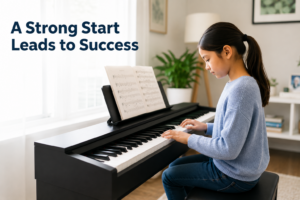
One of the most common questions we hear from new piano families is:
“Do I really need a piano, or can my child learn on a keyboard?”
We understand why this question comes up. Parents are often trying to balance space, budget, and the uncertainty that comes with starting a new activity. No one wants to make a large investment before knowing whether their child will stick with lessons.
The short answer to this question is that many students can begin successfully on a digital instrument. When an acoustic piano isn’t available, our best recommendation is choosing a full-size, 88-key digital piano with weighted keys rather than a smaller, unweighted keyboard.
The good news is that the price of many entry-level weighted keyboards or digital pianos is often much lower than people expect. With guidance from a Lessons In Your Home director, families can frequently find quality digital pianos starting around $500 that provide a much better long-term learning experience than a smaller, unweighted keyboard.
Why the Feel of the Keys Matters
The biggest difference between a piano and a typical keyboard is something called the action.
When you press a key on an acoustic piano, you’re activating a complex mechanism that causes a hammer to strike a string. That process creates resistance. The keys have weight to them. They push back against your fingers.
Most inexpensive keyboards don’t work that way.
Their keys are much lighter and require very little effort to press. While this can seem easier at first, it creates a problem for students learning piano technique.
Learning to play the piano isn’t just about knowing which notes to press. It’s also about learning how to press them.
Students develop muscle memory, finger strength, hand position, wrist movement, and control over dynamics from the very beginning. Keyboard with weighted keys help build those skills because they respond much more like a real piano.
Technique Begins on Day One
Most of our students are between five and twelve years old.
At these ages, they’re developing physical habits that can last for a lifetime. The relationship between their hands, wrists, arms, shoulders, and the keyboard is extremely important.
A full-size piano or keyboard places the keys at the same width and spacing that pianists will encounter on any piano they play anywhere in the world. When students learn on a standard size instrument, their hands learn proper distances. Their fingers learn proper shapes. Their wrists learn proper alignment.
When a child practices on a smaller keyboard with narrower keys or fewer keys, they’re learning movements that may not transfer well to a real piano later.
It’s similar to learning basketball on a hoop that’s several feet shorter than regulation height. You can still learn some skills, but eventually adjustments become necessary.
A full-size instrument gives students the opportunity to develop healthy technique from the beginning.
Your Child Is Training Their Ears Too
Another reason weighted keys matter has nothing to do with fingers and everything to do with listening.
Good piano playing is a constant back and forth between what a student does and what they hear.
When a student presses a key lightly, they hear one sound. When they press it with more weight and control, they hear something different. Over time they learn to shape phrases, create contrast, and express emotion through their touch.
This connection between movement and sound is one of the foundations of musical development.
Because weighted keys respond more like an acoustic piano, students learn to connect their physical actions to the sounds they create. This helps develop both technique and musicianship simultaneously. Weighted and touch-sensitive actions are widely considered important for learning dynamic control and expressive playing.
What Happens When Students Switch?
One challenge we frequently see occurs when a student practices on an unweighted keyboard at home and then plays on an acoustic piano during a recital, competition, school performance, or even a lesson.
Suddenly the instrument feels completely different.
The keys are heavier. The response is different. The student’s fingers aren’t accustomed to the amount of control required.
It’s not unusual for students in this situation to feel frustrated because they can play a piece successfully at home but struggle when they encounter a real piano.
Starting on a weighted instrument helps eliminate much of that transition.
Do Beginners Really Need All 88 Keys?
For the first few months of lessons, many introductory songs don’t use all 88 keys.
However, students often outgrow smaller keyboards sooner than parents expect. As repertoire advances past the very early beginner level, the full range of the piano becomes increasingly important. Many teachers and examination systems recommend or require full-size, weighted instruments because students eventually need access to the complete keyboard.
A full-size instrument gives students room to grow without needing another upgrade after the first few months of lessons.
We Understand Budget Concerns
None of this means families need to purchase an acoustic piano before starting lessons.
In fact, many of our students begin on digital pianos and make excellent progress.
Our goal isn’t to encourage families to spend more money than necessary. It’s to help them avoid spending money twice.
A smaller keyboard may seem like the less expensive option initially, but many families end up replacing it once their child becomes more serious about lessons. Starting with a quality weighted digital piano often provides a better value over time.
Our Recommendation
If an acoustic piano isn’t available, we recommend:
- 88 full-size keys
- Fully weighted or hammer-action keys
- Touch-sensitive response
- A stable stand and bench that promote proper posture
- A sustain pedal
This setup gives students the closest experience to an acoustic piano while remaining affordable, portable, and practical for most homes.
Most importantly, it allows your child—or you—to build the same techniques, habits, and listening skills that will transfer to any piano they encounter in the future.
The goal isn’t simply to learn songs.
The goal is to learn piano.
And the closer the instrument feels to a real piano, the easier that journey becomes.