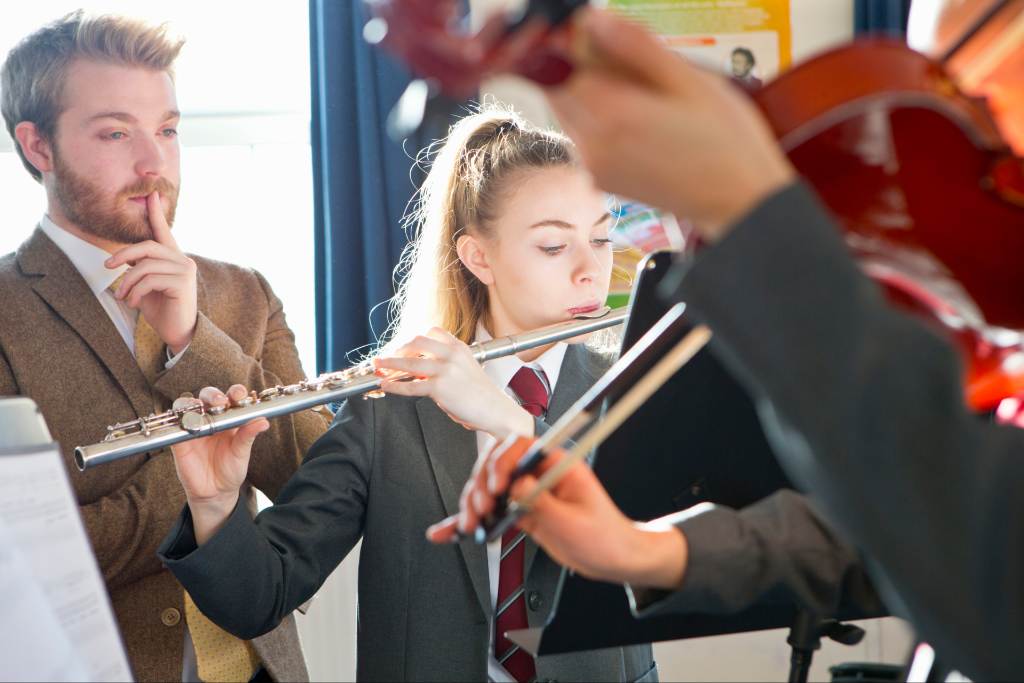
Almost every student gets nervous before a recital, and almost every one of them settles the moment the preparation starts to feel real. Nerves tend to grow in the gap between wanting to play well and knowing how you will get there, so the surest way to calm them is a plan you can see. Good preparation usually spans six to eight weeks, and it moves through a natural arc: choosing the right piece, learning it section by section, bringing it together, and rehearsing the performance itself until walking onto a stage feels ordinary. What follows is how that arc tends to unfold week by week, along with the part parents play in it, which matters more than most families expect.
What Good Preparation Gives a Student
Preparing well does more than get a student ready to play the notes. A recital on the calendar turns weekly practice into work with a clear destination, and students who have something real to aim for tend to practice with more purpose. Staying with one piece over several weeks teaches a student to keep refining something after the easy progress is behind them, which is its own skill. And because good preparation rehearses the performance and not only the music, a student arrives having already practiced the walk up, the first note, and the bow. By the day itself, the stage is one of the few things that still feels new, and even that has been softened by a mock run or two.
A Week-by-Week Approach to Recital Preparation
Think of the plan below as a map rather than a set of rules. It runs about eight weeks, which suits a late-beginner comfortably, though a teacher will stretch it for a harder piece or reshape it to fit the student in front of them. Here is the whole arc at a glance before we walk through each week.
| Focus | What happens | |
|---|---|---|
| Week 1 | Choosing the piece | Teacher shortlists options, student picks a favorite, and the piece gets divided into sections. |
| Week 2 | Working through it | First feedback on tough passages, and a tempo goal set for performance day. |
| Week 3 | Bringing sections together | Sections become fluent, and work on expression begins. |
| Week 4 | Playing it whole | Aim for a full run-through by week 5, focused on the overall idea over small mistakes. |
| Week 5 | Hearing progress | The piece runs through with only a few slips, with extra attention on the ending. |
| Week 6 | The mock recital | A full performance cold, no warm-up, with an audience invited to add pressure. |
| Week 7 | Easing the pressure | Lighter recital work and a change of pace to take the edge off. |
| Week 8 | The final week | Rehearsing the full flow, bowing and stage movement included, and playing for family at home. |
Week 1: Choosing the Recital Piece
The teacher brings examples of good recital piece selections that the student could play in an upcoming recital that is two months away. They go through the choices together and arrive at the student’s favorite. The choice has been made, and together in the first week of preparation, the teacher and student go through the piece and establish a way of sectioning it, choosing smaller areas to work on for the next few weeks of lessons. The student’s responsibility before week 2 is to look through the piece and start familiarizing themselves with it by identifying difficult passages and working on the first outlined section.
That piece-picking week carries more weight than it looks. As Marilyn Tovy, one of our Houston directors, describes her own process: the pieces “can’t be too easy or too challenging,” and most importantly they should be fun to play and crowd-pleasers. She shortlists two or three songs per student, then lets the student make the final call, which gives them a sense of pride and ownership in their song. One of her students, Abby, once greeted her at the door with “are we picking my recital song today?!?!” The same principle holds across instruments, whether a student is preparing a piano piece, a guitar solo, or a voice selection: the right piece is one they are glad to play.
Week 2: Working Through the Music
During this lesson, the teacher checks the student’s progress and gives feedback on the work thus far. The first week may have a student thinking the piece they selected is a bit difficult or extensive, but hang in there, since this is a long-term project. The student receives normal feedback from the teacher on how to proceed and work through tough areas, as well as a tempo goal to achieve by the performance date.
Week 3: Bringing the Sections Together
By week 3, the student can play through the recital piece. They continue on much like week 2, with more sections of the recital piece being completed so they are fluent. The piece is coming together, and any remaining sections should be worked through before week 4 so that continuity and tempo goals can be reached. Week 3 is also when the teacher and student talk about expression and what they are trying to say while playing the recital music. They set expectations and establish the sections the student should focus on.
Week 4: Playing the Piece as a Whole
The teacher establishes a goal this week to be able to play through the entire recital piece by week 5, which is the half-way point in the preparation process. The teacher tells the student not to worry about small mistakes, but to concentrate on the overall idea of the piece. The student is reminded of musical goals, dynamics, and tempo.
Week 5: Hearing the Progress
By this week, the student is running through the piece and able to play through with only a few mistakes. The recital preparation is paying off. If the tempo needs to be increased, that can be a goal for the coming week. In this example, the teacher is very mindful of the end of the piece, rather than the beginning, as the start is most likely strong by week 5, though the end of the piece may not have the same fluency. Any small sections or mistakes will be explored by the teacher, with the goal of running through the entire piece as it will be played in the recital by the next lesson.
Week 6: The Mock Recital
The run-through! The teacher has the student do a mock-performance of the entire piece and provides more feedback. At this point, the piece is completely prepared, with a focus on playing without a warm-up being emphasized. The teacher also encourages the student to do more mock recital preparation with frequent breaks, to see how they approach the piece cold, which is the difficult part about recitals in general. The student is encouraged to invite people to watch, to create the kind of pressure they will feel at the recital itself.
Week 7: Easing the Pressure
The teacher wants to take some pressure out of the performance, so the student works mostly on weekly assignments instead of too much of the recital piece, though they will still play through it. The student keeps practicing it as normal to continue improving continuity, but it is good to feel the change of pace in this week’s lesson and lighten the pressure.
Week 8: The Final Week Before the Recital
The final lesson before the recital! The teacher practices the performance flow with the student, including bowing, approaching and exiting the stage, and the piece itself. As a final suggestion, the teacher recommends that the student play the piece for as many people in their household as possible before the recital, as this is a different type of practice in itself and is the closest experience to the actual recital that can be created.
Though the example above uses an eight-week process, the timeline can be expanded and spread out over longer periods, since there are many larger works a student will work on for more than eight weeks. The key point, for both teachers and students, is to have a solid plan and start working early.
How Parents Can Help During Recital Season
You do not need to read music or have played an instrument to be a real help during recital season. Most of what a child needs from a parent has little to do with the notes and everything to do with the mood around them.
- Learn the shape of the plan. Once you know the piece should feel comfortable by around week 5 and polished by the day itself, you can encourage what is going well at home without pressing for a finished performance before it is time.
- Keep your own nerves to yourself. Children read their parents closely, and a worried parent tends to raise a worried child. A calm, ordinary presence in the weeks beforehand steadies a student more than any reassurance offered on the day.
- Let them perform before they perform. A piece played for grandparents, a neighbor, or a younger sibling loses some of its terror by the time it reaches the stage. Every small audience makes the real one feel more familiar.
- Protect the day before. A light run-through, an early night, and a calm evening will serve a child far better than a last push, which usually unsettles more than it sharpens.
- Start with what they did, not what they missed. The first words a child hears coming off the stage stay with them. Meet them with the fact that they got up and played, and leave any wrong note for the teacher, who can make something useful of it at the next lesson.
If you are weighing whether recitals are worth the nerves in the first place, why music recitals matter for students lays out what a child gains from performing. And when nerves are the real hurdle, our teachers who help students calm performance nerves treat them as an ordinary part of learning to play, never as a flaw to correct.
We Help Students Grow Through Every Recital
A recital is not the finish line. It is one of the clearest moments a student gets to see how far they have come, and to feel it in front of the people who matter to them. Everything we do in the weeks beforehand is built to get a student there ready and proud, not just rehearsed. A recital ready student is the aim of how we teach, and it shapes what makes great music lessons for kids at every stage, long before a recital is on the calendar. If your child is getting ready to perform, or simply curious about starting music lessons, get in touch and we will match them with a teacher who will help them grow at their own pace.
Frequently Asked Questions About Recital Preparation
How long does it take to prepare for a music recital?
Six to eight weeks suits most pieces chosen for a student’s level, with more time set aside for anything ambitious. That window gives a student room to learn the piece, polish it, and rehearse the performance without racing the clock. Of everything that lowers recital-day stress, starting early does the most.
How should a student choose a recital piece?
The teacher usually offers two or three pieces matched to the student’s level and personality, then leaves the final choice to the student. A good recital piece sits a little below what a student can technically manage and is genuinely fun to play, since enjoyment is what keeps them practicing it. Making the final call themselves gives a student a real stake in the performance.
What is a mock recital and why does it help?
A mock recital is a full, start-to-finish run of the piece played cold, without a warm-up, usually a week or two out. It rehearses the hardest part of performing, walking up and playing without easing into it, exactly as the real day will ask. Inviting a few people to watch adds a touch of the pressure the student will feel on stage, so that pressure is familiar rather than new.
How can a student calm nerves before performing?
Slow, steady breaths and warm hands settle the body in the minutes before playing, and rehearsing the walk on and off stage removes the small surprises that rattle students most. Nerves rarely vanish completely, even for seasoned performers, so the aim is to make them manageable rather than gone.
Should parents help their child practice at home?
No musical training is needed to help at home. Knowing the rough timeline, keeping the atmosphere calm, and lining up a few gentle audiences of family and friends are the most useful things a parent can offer. A warm word after the performance will always matter more than a correction.
What should a student do the week of the recital?
The final week eases off rather than ramps up: lighter practice, one full run-through complete with bowing and stage movement, and a few performances for people at home. The goal is to arrive rested and at ease with the whole sequence, not worn out from cramming. A good night’s sleep before the recital is worth more than one more practice session.