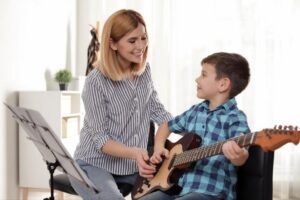
Most parents come to guitar lessons with the same handful of questions, even if they never quite say them out loud. Is my child old enough? Acoustic or electric? What if they hate it after a month?
Here’s the good news: guitar is one of the friendliest first instruments a kid can pick up. It shows up in almost every kind of music a child might love, most kids think it looks cool (huge bonus), and they can usually play a recognizable song within a few weeks of starting. That’s a fast win for a six-year-old.
What makes the difference in those first months isn’t the gear or the curriculum. It’s whether everything fits the child in front of you: from the age you start, to the size of the guitar, to the person teaching them. Let’s walk through it, in the order you’ll actually face the decisions.
When Are Kids Ready for Guitar Lessons?
Most kids are ready around age six or seven. By then they have the finger strength to press down a string firmly enough to make it sound clean, the fine motor control to land their fingers on specific frets, and the attention span to sit through a thirty-minute lesson without drifting. Some five-year-olds are ready earlier, especially with a parent willing to sit on the couch nearby for the first few months. Some eight-year-olds aren’t quite there yet, and that’s fine too.
Past the physical readiness, there’s a quieter signal that tends to matter more: is your child the one asking, or is it you? Kids who pick up the guitar because they want to almost always go further than kids who pick it up because a parent thought it would be good for them. A hesitant child can still learn to love it. The first few weeks just need to stay light, with a teacher who’s paying attention to the kid in the room rather than running through a lesson plan.
If you’re unsure, a trial lesson is usually the easiest way to tell. We’ve watched kids who seemed too young find their groove within ten minutes, and kids who looked ready freeze up the moment the guitar landed in their lap. Most teachers can read it within a lesson or two. Our guide to getting started with music lessons walks through what that first conversation usually covers.
Acoustic, Electric, or Classical: Which Guitar Is Best for Kids?
The good news is the “wrong” choice rarely matters as much as parents worry it will. What does make a difference is comfort: a guitar your child can hold without struggling and press the strings on without their fingers giving up after five minutes.
A classical guitar is often the gentlest place to start for younger children. The nylon strings are easier on small fingertips than steel, the neck is a bit wider so fingers have room to land cleanly, and the body is light. Classical guitars suit folk, fingerpicking, and traditional music more than the rock or pop your child might actually be listening to, so the sound is something to weigh.
An acoustic guitar with steel strings has the brighter, more familiar sound most parents picture when they hear the word “guitar.” Steel strings are tougher on new fingertips for the first few weeks until calluses build, but they’re not punishing, and most kids adjust quickly. Acoustics work well for pop, country, folk, and singer-songwriter music.
An electric guitar is lighter than most parents expect on the body but heavier in the hands because of the electronics inside. The strings are usually thinner and easier to press, and the neck is narrower, which can help small hands. The catch is that an electric needs an amplifier to be heard properly, which adds a bit of setup and a small extra cost. For a kid who loves rock, pop, or anything with a driving guitar line, an electric is often the instrument that gets them to practice without being asked.
If you’re still on the fence, follow the music your child already loves. The guitar that matches their taste is the one they’ll actually want to pick up.
What Size Guitar Should You Buy?
Type matters, and so does size. A guitar that’s too big for the player is one of the most common reasons early lessons stall out. You can spot it in the first week: a child whose shoulder is hunched, or whose fretting hand keeps slipping off the neck because they can’t quite reach.
- Ages 5 to 8: a 1/2-size guitar
- Ages 8 to 11: a 3/4-size guitar
- Ages 12 and up: usually a full-size
Heights vary, so a tall eight-year-old might be ready for a 3/4 and a small twelve-year-old might still do better on one. Trying a few in a music store helps, or your teacher can check the fit at the first lesson.
Beginner Guitar Accessories Worth Buying
The list of accessories that actually matter is short:
- A clip-on tuner, because an out-of-tune guitar makes a beginner sound worse than they are
- A strap, if your child wants to play standing up
- A small pack of medium-thickness picks to start with
- A soft case so the guitar gets put away rather than left on the floor
For a deeper buyer’s guide with specific model recommendations, see our breakdown of the best guitars for kids starting out.
In-Home, Online, and Studio Guitar Lessons Compared
Once you’ve got a guitar, the next question is where the lessons are going to happen. Format matters more than parents tend to expect, and the same child can have a very different experience depending on the setup.
In-home lessons mean the teacher comes to you. No driving, no waiting room, no rushing from school. The lesson happens in the same space your child will practice in, which makes the handoff between lesson and practice almost seamless. Most kids settle faster when the guitar is already in their hand and their teacher is in their living room than they would in a studio they’re still getting used to. This is the model Lessons In Your Home has been built around since 1997, and it’s why most of our students are kids.
Online lessons work well for older students who can focus through a screen. Younger kids often struggle with the format because the teacher can’t physically adjust a finger position, and the abstraction of a screen wears on short attention spans. Online is a great option when geography or scheduling rules out anything else, and we offer it across all of our locations.
Studio lessons at a music school offer structure, exposure to other students, and recitals built into the calendar. The downsides are the commute, the waiting room time, and scheduling around the studio’s availability rather than yours.
What to Expect From Your Child’s First Guitar Lessons
Parents often picture the first lesson as the moment their child starts strumming a song. The reality is quieter, and a quieter first lesson is usually a good sign.
The first lesson is mostly orientation. Your child’s teacher will go over how to hold the guitar, the names of the strings, where the frets are, and how to make a string sound clean instead of buzzy. Your child probably won’t play a full song, and they shouldn’t be expected to. What matters is whether they leave the lesson curious to come back.
From there, here’s a rough sense of what the first six months tend to look like:
| Timeframe | What kids are learning | What it usually sounds like |
|---|---|---|
| Weeks 1–2 | Parts of the guitar, how to hold it, basic strumming, single-string melodies | Slow, careful single notes. A simple tune like “Mary Had a Little Lamb.” |
| Weeks 3–4 | One-finger and two-finger chords (Em, Am), basic strumming patterns | A short two-chord song played end to end, with pauses to switch chords. |
| Months 2–3 | A handful of basic chords, smoother transitions, simple rhythm patterns | Simple full songs from start to finish, still with hesitation between changes. |
| Months 4–6 | Five to eight chords, faster chord changes, first attempts at songs they actually like | Real songs that sound recognizable. Some kids start asking to learn harder material. |
At this stage, reading music isn’t usually required. Most beginner instruction uses chord diagrams and fret numbers, which kids pick up faster than standard notation. Some children will be asking for harder songs by month four. Others will still be working on the same five chords, and that’s normal too.
What to Look for in a Great Guitar Teacher for Kids
The teacher is the single biggest variable in whether a child sticks with guitar. More than the guitar itself, more than the format, more than how much they practice. The best teachers for kids are skilled musicians, yes, but the part that keeps a seven-year-old coming back is harder to put on a resume. It’s the ability to read the kid in front of them and adjust.
A few qualities worth looking for:
- Experience teaching children specifically. Teaching a seven-year-old is a different skill than teaching an adult or a teenager. The pacing is slower, the language is different, and the lesson plan has to bend around a kid who suddenly wants to talk about their lost tooth.
- The ability to read mood and adjust pace. A kid who shows up tired or distracted needs a different lesson than one who shows up buzzing. A great teacher notices, and shifts.
- A range of musical styles. The song that gets your child to practice might be from a movie soundtrack, a video game, a pop hit, or their grandfather’s favorite folk song. A teacher who can pivot keeps lessons interesting.
- Patience with practice gaps. Every kid will have weeks where the guitar barely gets touched, and a teacher who treats that as a normal part of learning will keep the child engaged longer.
The clearest sign you’ve found the right teacher is whether your child looks forward to the lesson. They mention their teacher by name at the dinner table. They want to show you what they learned, even if it sounds rough.
Finding that fit can be the slowest part of starting lessons, which is why we match every Lessons In Your Home student to a teacher based on instrument, schedule, location, and personality, rather than assigning whoever is free. A shy seven-year-old who loves Taylor Swift won’t be paired with a jazz purist whose style is intense and technical, even if both teach guitar. Every music teacher on our staff is background-checked, trained, and supported throughout the year, so the match is the variable, not the quality of the person.
Start Guitar Lessons With Lessons In Your Home
The right start comes down to three things: a teacher who pays attention, an instrument that fits, and a pace that respects your child. Get those in place and the rest tends to sort itself out. We’ve spent nearly thirty years matching kids with teachers who understand that music lessons are built on trust, encouragement, and connection.
Ready to find the right teacher for your child? Get in touch today, and we’ll match them with someone who fits their instrument, personality, and schedule.
Frequently Asked Questions About Guitar Lessons for Kids
What is the youngest age a child can start guitar lessons?
Some children can begin as young as five with the right teacher and a parent willing to sit in on early lessons. Most kids do best starting at six or seven, when their hands are strong enough and their attention span is longer. A teacher can usually tell within a lesson or two whether a child is ready.
Is it better to start a child on guitar or piano?
Both work well as first instruments, and the right choice depends on your child. Piano makes music theory visual and is easier for very young children to make a clean sound on. Guitar tends to be more portable and shows up in more of the music kids actually listen to. If your child has a strong preference, follow it.
How much do guitar lessons for kids cost?
Private guitar lesson rates vary by region, teacher experience, and lesson format. In most areas, weekly thirty-minute private lessons fall within a typical range for private music instruction, with in-home lessons sometimes priced slightly higher to account for teacher travel. The most reliable way to get accurate pricing is to ask a local provider directly.
What if my child wants to quit after a few months?
A few months in is often when novelty fades and the work of learning starts to feel real, so some pushback is normal. Talk to the teacher before making any decision. Often a small adjustment, like switching to songs your child actually likes or changing the lesson day, brings the interest back.
Do guitar lessons for kids work over Zoom?
They can, especially for older students who already know how to focus on screen. Younger children often struggle with the format because the teacher can’t physically adjust their hand, video lag makes playing together hard, and the abstraction of the screen wears on short attention spans. In-person lessons tend to work better for kids under about ten.