Making Piano Lessons Fun
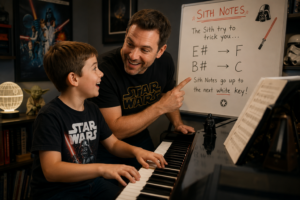
“These are Sith Notes,” Jim told him.
That was all it took.
Jim had a young piano student who loved Star Wars. He liked the characters, the stories, the battles, the whole world of it. Piano, on the other hand, did not always hold his attention in quite the same way.
That is not unusual with young students. A child can be interested in music and still have a hard time staying focused through every explanation, every correction, and every new idea. Sometimes the challenge is not whether the student can learn the concept. Sometimes the challenge is finding the door that gets them interested enough to walk through it.
For this student, the door had a lightsaber.
Jim was working with him on sharps, including two of the trickier ones: E sharp and B sharp. For many students, those notes are confusing because they do not look the way sharps usually look on the piano. Most beginners learn that a sharp moves a note up to the next black key. But E sharp and B sharp are different. They land on white keys.
That makes them feel a little sneaky.
So Jim gave them a name.
Sith Notes.
Suddenly, the theory lesson had a story. E sharp and B sharp were not just strange exceptions on the keyboard. They were notes from the dark side, tricking pianists by hiding in plain sight. The student understood the joke, and because he understood the joke, he remembered the idea.
The lesson changed after that. Not because Jim stopped teaching piano, but because he found a way to teach piano through something the student already loved. The music did not become less serious because it became more playful. It became more reachable.
That is one of the quiet skills of a good teacher. You can know the material perfectly and still miss the student. Jim did not miss him. He noticed what made this child light up, and he used it to make the lesson work.
There is a big difference between distracting a student and connecting with one. This was not a break from learning. It was learning, just translated into the student’s language.
Some students need a careful explanation. Some need to move around. Some need a challenge. Some need a game, a story, or a funny name they will not forget. In this case, a pair of confusing sharps became part of a galaxy far, far away.
And the student learned them.
Years from now, he may not remember every scale he practiced or every page in his piano book. But there is a good chance he will remember that E sharp and B sharp were Sith Notes.
He may also remember something even more important: that his teacher paid attention.