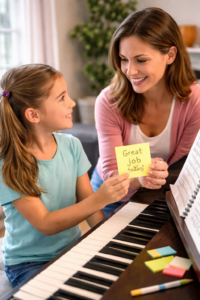
A parent once told us something simple after a lesson:
“I love when I get those little updates. It helps me feel like I’m part of what’s happening.”
Nothing about the lesson had changed. The teacher was doing a great job, the student was progressing, everything was on track.
The only difference?
Communication.
A Small Message, A Big Difference
That week, the teacher sent a quick message after the lesson:
“Today we worked on keeping a steady rhythm in her new song. She did a great job staying focused, and it’s really starting to click. Next week we’ll keep building on that.”
It took less than a minute to write.
But for the parent, it meant everything.
Because now they knew:
- What their child was working on
- What progress looked like
- What to expect next
And more importantly, they felt connected.
What Communication Really Does
Moments like that aren’t just helpful—they’re meaningful.
They send a message, even beyond the words themselves.
They say:
We’re paying attention.
We care about your child.
This matters to us.
Without that communication, a lesson can feel like a mystery. You know your child is learning, but you don’t always see how or why.
With it, everything becomes clearer.
Turning Lessons Into Something You Can See
Another parent shared that before receiving regular updates, they would always ask the same question after lessons:
“How did it go?”
And the answer was usually:
“Good.”
After a few weeks of more consistent communication, that changed.
Now they could ask:
“Hey, how’s that rhythm part coming along?”
And suddenly, the conversation was different.
More specific. More engaged. More encouraging.
That’s what purposeful communication creates.
Working Together
At Lessons In Your Home, we believe progress happens best when teachers and families are connected.
Communication is what makes that connection possible.
It helps you understand what your child is learning.
It helps us understand what matters most to you.
And it keeps everyone moving in the same direction.
Why We Focus On It
We don’t communicate just to check a box.
We communicate because it helps your child succeed.
It builds trust.
It creates clarity.
And it strengthens the relationship between you, your teacher, and your child.
And through it all, those same three things come through clearly:
We’re paying attention.
We care about your child.
This matters to us.
That’s what communicating with a purpose looks like.
And it’s something we’re committed to every week, with every lesson.