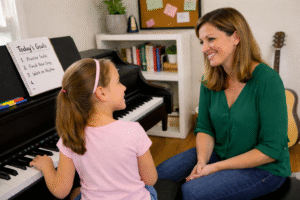
When parents picture a private music lesson, they often imagine a teacher arriving, opening a book, and helping their child play a song a little better than last week.
And yes — that’s part of it.
But behind every successful lesson at Lessons In Your Home is something far more intentional: a thoughtful, flexible lesson plan designed specifically for your child.
For parents of school aged students, this matters more than you might think.
Music Lessons Should Feel Fun — But Never Random
Children thrive on structure — even when they don’t realize it.
The best lessons feel relaxed, engaging, and fun. But underneath that fun is a clear plan:
- What skill are we strengthening today?
- What concept needs reinforcement?
- What is the next small step forward?
- How will we build confidence before the lesson ends?
Without a plan, lessons can easily drift into “just playing songs.” And while playing songs is wonderful, long-term growth happens when each lesson intentionally builds on the last.
At Lessons In Your Home, our teachers don’t just teach music — they guide progress.
What a Lesson Plan Looks Like for a 7-Year-Old
It doesn’t look like a complicated document.
It looks like this:
1. Warm-Up (Build the Foundation)
Scales, rhythm clapping, hand position, bow hold — simple exercises that quietly strengthen technique.
2. Review (Celebrate and Correct)
We revisit last week’s assignment.
We reinforce what went well.
We gently correct what needs adjusting.
3. New Skill or New Section (Grow Forward)
Maybe it’s learning skips on the staff.
Maybe it’s using the fourth finger.
Maybe it’s reading bass clef for the first time.
The new concept is introduced in manageable pieces so your child feels challenged — but successful.
4. Clear Practice Plan (Set Up the Week)
We don’t just say, “Practice this.”
We explain how to practice it.
That clarity builds independence and confidence.
Why This Matters for Ages 5–12
Between ages 5 and 12, children are developing:
- Attention span
- Fine motor control
- Reading skills
- Emotional resilience
- Confidence in learning new things
A strong lesson plan supports all of these.
When lessons have structure:
- Children feel secure.
- Progress is steady.
- Frustration is reduced.
- Motivation stays high.
- Parents see measurable growth.
When lessons lack structure, children often:
- Lose focus
- Practice inconsistently
- Feel unsure of expectations
- Plateau sooner than they should
Young students need guidance — not guesswork.
Every Child’s Plan Is Different
One of the most important parts of our teaching philosophy is personalization.
A lesson plan for an energetic 6-year-old beginner looks very different from a focused 11-year-old preparing for a recital.
Our teachers adjust for:
- Personality
- Learning style
- Pace of progress
- School workload
- Confidence level
- Musical interests
Some students need more repetition.
Some need more challenge.
Some need more encouragement.
Some need more structure.
A good lesson plan is not rigid. It’s responsive.
Flexibility Is Part of the Plan
The best teachers plan carefully — and adapt instantly.
If a student:
- Had a tough week at school
- Didn’t practice as much as planned
- Is feeling extra confident
- Is struggling with a specific concept
The teacher adjusts in real time.
A lesson plan is not a script.
It’s a roadmap.
And great teachers know when to take a detour.
Progress You Can See
Parents often ask, “How do I know my child is improving?”
The answer isn’t just in the songs they can play.
It’s in:
- Stronger rhythm
- Better posture
- More confident reading
- Increased independence in practice
- The ability to solve small problems on their own
When lessons follow a thoughtful progression, growth becomes visible — and sustainable.
Building Musicians — Not Just Song Players
Anyone can help a child memorize a few songs.
But teaching a child to:
- Read music confidently
- Understand rhythm
- Develop technique
- Practice effectively
- Build resilience when something is hard
That requires intention.
At Lessons In Your Home, we believe each lesson should move a student one clear step forward — even if it’s a small one.
Over weeks and months, those small steps become real musical ability.
For Our Teaching Community
Parents may see the smiling faces and hear the music — and that’s wonderful.
But behind every successful lesson is preparation.
The quiet decisions:
- What skill needs reinforcing?
- Where is this student headed?
- What is today’s priority?
- How do we build both ability and confidence?
Thoughtful planning doesn’t make lessons rigid.
It makes them purposeful.
And purposeful lessons build lifelong musicians.
When your child’s teacher arrives each week, they aren’t just bringing music.
They’re bringing a plan — designed to help your child grow, succeed, and love the journey of learning.
That’s the difference intentional teaching makes.