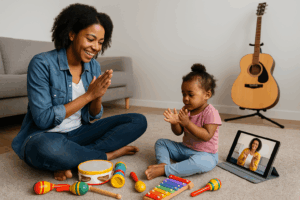
Music isn’t just a skill—it’s a gift we can give our children starting at day one. In our work with families across the country, we’ve seen the long-term benefits of raising musical children early, from improved language development to stronger emotional expression.
You don’t have to wait until your child can sit at a piano or hold a violin. Music can start with a lullaby, a dance around the kitchen, or a shared giggle during rhythm play.
Music for Babies: It Starts with Sound
Infants are wired to respond to rhythm, pitch, and the soothing quality of a familiar voice. Here are some ideas for musical bonding with babies:
- Sing lullabies while rocking or feeding
- Gently pat a beat on their tummy or back
- Introduce soft instruments like maracas or egg shakers
- Hum familiar tunes to build comfort and memory
Even if you feel “musically untrained,” your baby loves the sound of your voice. That’s where the musical journey begins.
Musical Toddlers: Move, Play, Imitate
Toddlers are curious, wiggly, and eager to copy. This is the perfect time to introduce simple rhythm games, clapping patterns, and call-and-response songs.
Try these activities:
- Tap wooden spoons together to create beats
- Clap a rhythm and let your toddler copy it
- Dance to upbeat music and freeze when it stops
- Sing a simple tune and change the tempo for fun
Children at this stage thrive on repetition and silly songs—both of which lay the foundation for strong musical memory and rhythm.
Preschool and Early Elementary: Start Instrument Exploration
As kids get older, they’re ready for more structured musical experiences—like learning an instrument, joining a group class, or taking private lessons at home.
In fact, many of our private music students start as early as age 4. The key at this stage is to keep learning playful and praise-filled.
We use musical games, story-based songs, and visual aids to help young students understand abstract concepts like pitch, duration, and dynamics. And when parents participate—even just by sitting nearby—it boosts focus and motivation.
Why It Matters
According to the American Psychological Association, music supports brain development, language acquisition, and emotional regulation in young children. It’s one of the few activities that activates both hemispheres of the brain at once.
FAQ: Raising Musical Children Early
What age should my child start music lessons?
Many children can start informal music activities as infants, but private lessons typically begin around age 4 or 5.
Do I need to be musical to raise a musical child?
Not at all. Your enthusiasm, consistency, and support are more important than perfect pitch.
How much screen time is okay for musical games or apps?
We suggest balancing screen use with hands-on, real-time musical play. Apps can support learning but should not replace interactive music-making.