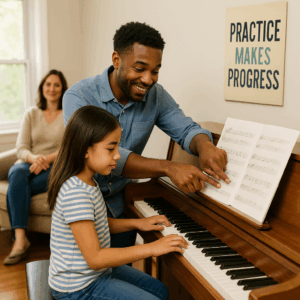
When it comes to learning an instrument, most students (and even some parents!) assume you should always practice from the beginning of a piece to the end. But as music teachers who work closely with beginner students, we can confidently say this: backwards practice works best.
That’s right—starting at the end of a piece and working your way backwards can actually help students learn faster, perform better, and feel more confident. And it’s not just a quirky teacher trick. There’s real logic (and brain science) behind it.
What Is Backwards Practice?
Backwards practice is exactly what it sounds like: instead of starting from the beginning of a song or exercise, you start near the end and work your way backward in small sections.
Here’s how it works:
- Learn the last measure or phrase first.
- Then add the phrase before that, and play both together.
- Keep repeating the process, gradually building back to the beginning.
By the time you reach the start, you’ve already mastered everything that comes after it.
Why Backwards Practice Works Best for Beginners
This method might feel a little strange at first, but there are several powerful reasons why it works—especially for new musicians:
- It builds confidence – Students finish strong because the ending is what they know best.
- It reinforces memory – Repetition from the end backwards helps embed transitions in long-term memory.
- It prevents burnout – You avoid the common trap of playing the beginning over and over while the end stays weak.
We talk more about musical memory and learning strategies in this related post.
And according to Psychology Today, people naturally remember the beginnings and ends of things better—so why not use that to your advantage in practice?
Tips for Trying Backwards Practice at Home
Want to try it? Here’s how we recommend beginner students practice backwards effectively:
- Use small sections – 1–2 measures at a time is enough.
- Repeat each section multiple times before moving on.
- Keep a pencil handy to mark tricky transitions.
- Record yourself to hear your progress and catch small errors.
- End your practice session on a section you feel great about—that’s the last thing your brain will remember!
FAQs About Backwards Practice
Q: Is backwards practice only for advanced students?
No! It’s a great tool for beginners and often easier for them to manage small sections this way.
Q: Can I use this with singing or guitar?
Yes—backwards practice works for any instrument, including voice, guitar, piano, and strings.
Q: Won’t this confuse my child?
It may feel unusual at first, but with a teacher’s guidance, students usually take to it quickly and love the results.